Ming Cheuk and I met properly on the AI Forum NZ trip to China, going behind the scenes at a long list of AI and robotics companies. Ming is co-founder and CTO of ElementX, which started in 2013 and built its first chatbot in 2016, so he has watched this whole wave from well before ChatGPT. He came over for a catch-up, we got talking, and we decided to turn the cameras on.
What came out was a good recap of what we saw in China, lined up against what we are both seeing with New Zealand clients right now. Here are the parts NZ businesses should pay attention to. If you missed the trip itself, start with I spent 7 days inside China’s AI revolution.
How is AI search changing for businesses?
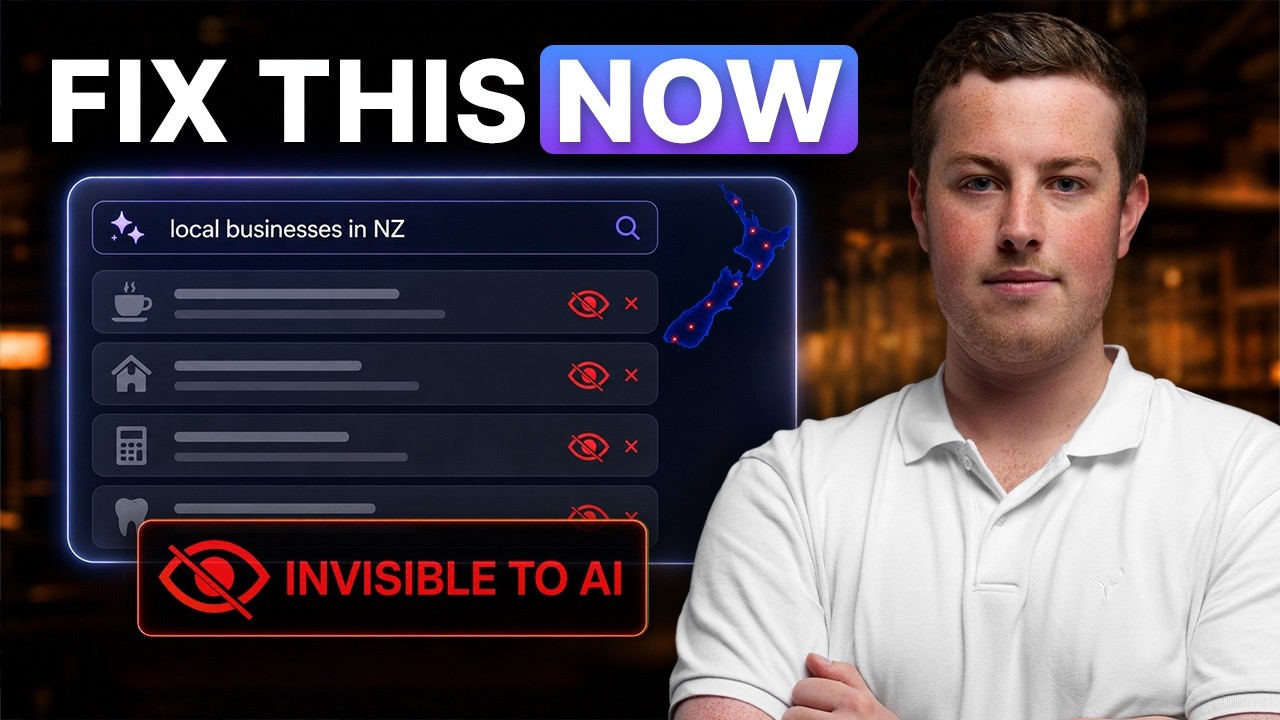
Just before we hit record we were talking about GEO - generative engine optimisation, or how your business shows up when someone asks ChatGPT, Claude or Perplexity instead of Google. I’ve put a lot of work into it, and I’m now getting a couple of leads a week coming from ChatGPT and other AI tools.
But it moves fast. Reddit had been one of the biggest sources ChatGPT cited, at around 40% of references, and a headline we had both seen said that had dropped to almost nothing within a couple of weeks. If you were paying someone for a Reddit-only GEO campaign, that is a rough month.
Ming’s point was that GEO is even more dynamic than SEO ever was. SEO at least had a formula. Now different AI agents use different search methods, and the biggest change is volume: it is no longer just your website, it is whether you are mentioned across LinkedIn, YouTube, Reddit and everywhere else. That is a big part of why content like this video matters.
One more catch: you are not only competing with other businesses. ElementX’s head of marketing built her own GEO tracker, and a lot of what comes up next to them is straight AI-generated blog posts - some accurate, some outdated, and some recommending companies that no longer exist. The full how-to is in how to rank in AI search as a business.
Can you tell when something is written by AI?
More and more, yes. We talked about Anthropic’s announcement on watermarking AI-generated text. From my first look, it works through the wording the model chooses rather than something hidden in the background, so you can’t strip it by pasting the text into a file and copying it back out. Ming is fascinated by how you subtly change the wording without changing the meaning.
Even without a watermark, people are getting good at spotting it. Em dashes are the obvious one, but in tech circles there are memes about words like “load-bearing” and “smoking gun” that keep turning up in AI writing.
I’ve been through both ends of this. Originally I was bullish on just getting AI to write my LinkedIn posts and tweaking them until they sounded close enough. Then I noticed how many words in there weren’t me. Now I want the human touch on everything, but after reading so much AI text I catch my own vocabulary blending with it. Ming uses Claude differently: he brings the idea and gets Claude to help with the wordsmithing, and over time you work out a prompting style so it still sounds like you.
How do you stop getting AI slop?
Ming’s view, which I agree with: if what you’re producing gets called AI slop, whether that’s content or code, you’re probably using AI wrong. Either the prompt is so generic that it goes off and does its own thing, or the instructions were wrong to start with.
When clients tell me Claude or ChatGPT is doing something wrong, 99% of the time they haven’t given it the information, haven’t prompted it properly or haven’t given it examples. Email is the classic one. Ask ChatGPT to write an email and it knows nothing about you or your business. Tell Claude to look at your past emails to different clients, work out how you communicate, and turn that into a skill, and it becomes genuinely useful. I’ve written up exactly how to do that in get Claude to write your business emails in your own voice.
AI is pattern recognition. Most businesses are sitting on tons of data, and a few small changes - pulling in previous history, or giving it access to a system so it can look things up - make the outputs massively better. With the connectors now built into Claude, ChatGPT and most other platforms, that isn’t hard any more.
What does generative AI unlock for robotics?
Ming remembers hearing the founder of Boston Dynamics speak at an AI conference in Singapore a few years ago. His take was that the biggest thing generative AI gave robots was the cognitive side. The mechanics were already solved - fast, agile, two-legged robots - but they weren’t very smart.
That is improving, but it’s still task-specific. From the robotics companies we visited, it works well in industrial settings like smart pharmacies, where a robot moves a specific product from one place to another and you can collect data on exactly that job. A Kiwi household is a completely different problem: dynamic, unpredictable, and full of safety issues. That is why data capture is such a race. In the US there are offers to clean your house for free if the cleaner can wear a body suit covered in cameras, because the data is what they actually want. There is still a big gap between simulated data and the real world.
It is moving quickly though. Since our trip, Unitree has shown robots doing backflips metres in the air. Very strong, still not general intelligence.
Who controls your data, and what if your AI is switched off?
New Zealanders are cautious about data, and fair enough. Supermarkets here are bringing in camera-based theft detection. Huffer copped a backlash over designs that looked AI-generated. Then, almost the same day in China, we watched AI clones of celebrities selling products on live streams for Baidu. They were labelled as AI, answered questions from the chat in real time, and the sellers found no drop in sales - in some cases an increase. Do that with an AI clone in New Zealand and your brand gets cancelled.
What China does have is clarity. China Construction Bank talked us through very clear standards on where and how AI and agentic AI can be deployed, with safeguards built in. Self-driving car companies were strict about the data they capture, because it maps your streets and your people. Compare that to New Zealand, where it is still close to anyone can do anything - and Teslas have been capturing data on our roads for an overseas company for years.
The bigger risk for businesses is dependence. Data centres are a live debate here, with protests and plenty of misinformation on both sides. But the practical question is simpler: if the model your business runs on was switched off for New Zealand users tomorrow, what is your backup? We saw a lot of open-source models in use in China. As Ming put it, with generative AI embedded in organisations and government, we don’t want to be at the mercy of one model, one supplier or one country.
What are the real risks of moving this fast?
There is huge upside. AI is already speeding up drug discovery, and Anthropic, OpenAI and DeepMind’s Demis Hassabis are all putting serious effort into life sciences. But like any tool there are positives and negatives - you can use a knife to cook or to hurt someone. The difference with AI is the speed, and nobody has the perfect answer. The useful position is somewhere in the middle of “every business must use AI” and “no AI at all”.
Some of the concern is overblown. I posted a TikTok about the Alibaba hotel where your face gets you into the lift, the restaurant and your room, and got a comment saying they’ll track your every move. Your phone is already doing that.
Some of it is very real. The first time you talk to an AI there’s a wow factor, and it is easy to go down a rabbit hole if you don’t realise it can be sycophantic - telling you what you want to hear. Early on I was asked a hard question: if your child was struggling with their mental health, would you rather they talked to nobody or to an AI chatbot? You don’t want people bottling things up, but AI can also push people down the wrong path. Ming has flagged AI companions as a gap before, when the AI Forum reviewed the international AI safety report, and there have been real tragedies with companion apps. Younger people without the experience to filter what the AI says are the most exposed.
What should NZ businesses do now?
- Be findable everywhere, not just on your website. AI search changes week to week. Spread your presence across LinkedIn, YouTube and real reviews rather than betting on one channel.
- Give AI context before you judge it. Your past emails, your documents, access to your systems. Generic in, generic out.
- Know where your data goes. Use paid plans for business work, read the privacy settings, and decide what should never leave the building.
- Don’t lock into one model you can’t replace. Keep your prompts, skills and processes portable so you have a backup if access changes.
- Keep a human filter on. AI is often confidently wrong and can be sycophantic. Check anything that matters before it goes out.
Thanks to Ming for an unplanned but very useful chat. Follow Ming and ElementX on LinkedIn for more good insights.