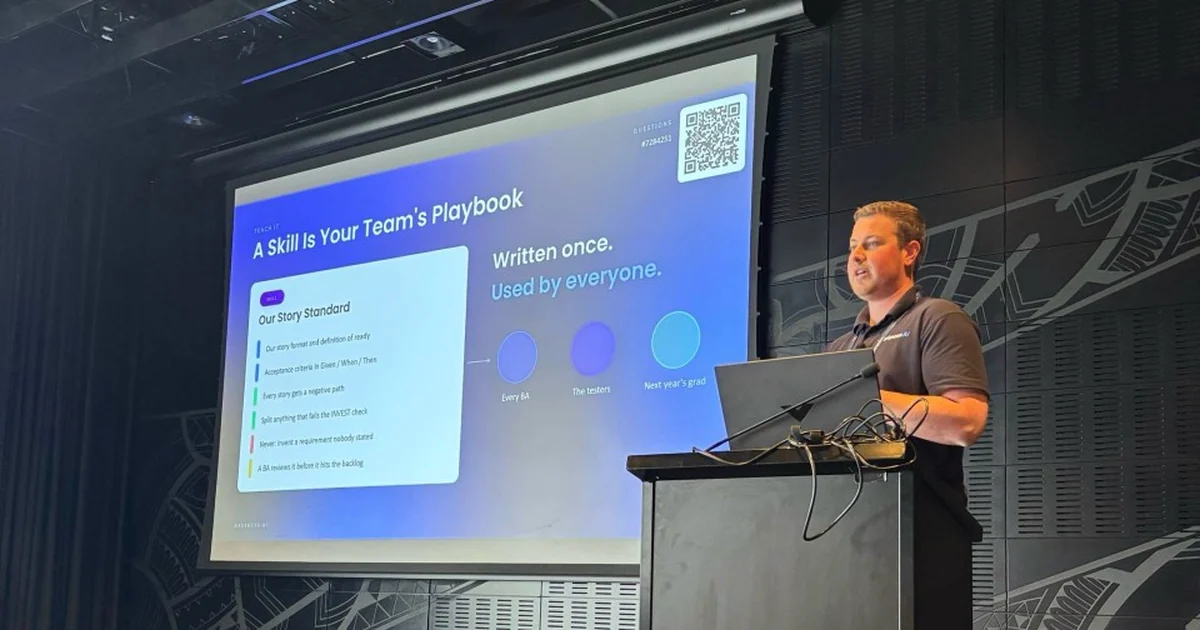
“AI isn’t a search tool any more. It’s the newest member of your team.” That was the line I opened with at the BA Big Day In at Tūranga in Christchurch on 16 October 2026, in front of 120-odd business analysts. The day was run by Analysis Collective Aotearoa, and my session, AI: What’s Actually Possible, was about what that new team member can actually do today, and how you onboard it.
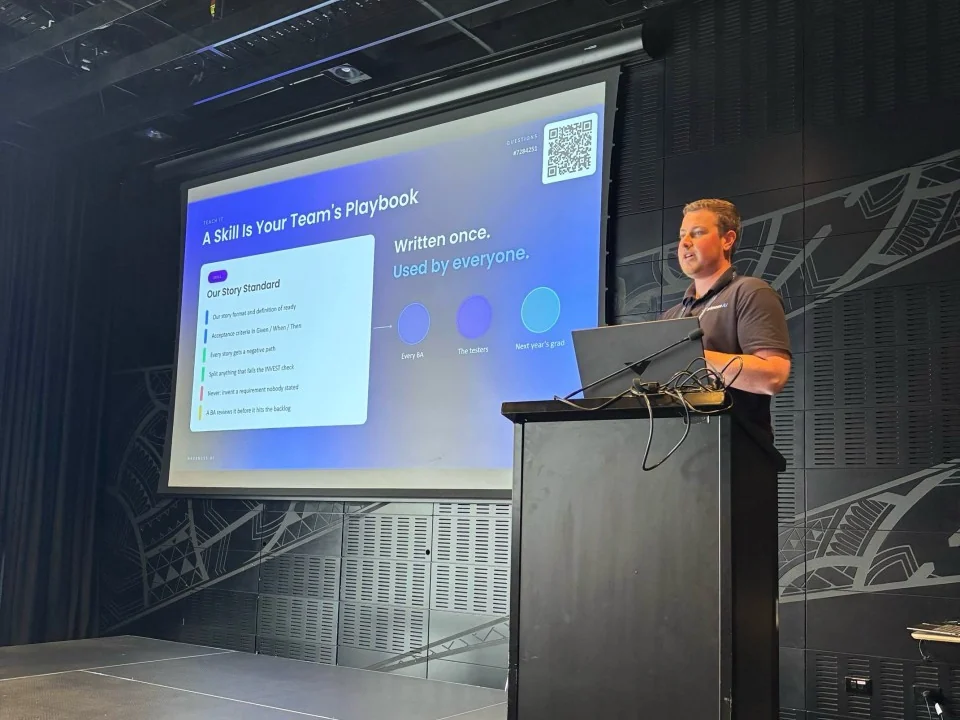
This is the teaching version of that talk, for BAs and for the leaders who manage them. Every demo ran on one fictional scenario: Northgate Mutual, a made-up New Zealand insurer modernising its claims intake.
Do business analysts need to be AI experts?
No, because nobody is an AI expert yet. Mainstream generative AI is about four years old. Most people in that room had 10 to 30 years in analysis and change. The skills that matter most with AI are the ones BAs already have: eliciting what people actually need, reading a room of stakeholders, and knowing which requirement is the real one.
Most BAs already see the upside. 69% say AI is positive for their career and only 5% see it as negative (IIBA Global State of Business Analysis 2026, 2,120 professionals in 122 countries). 84% of NZ knowledge workers already use generative AI (Accenture and Microsoft, New Zealand’s Generative AI Opportunity, 2024).
Meanwhile the capability is moving fast. METR measures the length of task a model can finish on its own half the time (its 50% task-completion time horizon, Time Horizon 1.1, September 2026). That has gone from about four minutes of human work for GPT-4 in 2023, to 3.4 hours for GPT-5, 12 hours for Claude Opus 4.6 and 17.4 hours for Claude Mythos Preview. METR flags readings above 16 hours as less reliable, so treat the top figure as a rough guide.
What is AI actually doing when it answers you?
It predicts the next word. It read the internet, but it has never read your Confluence pages, your process maps, your backlog, your stakeholders’ emails or what the last workshop agreed. That is why it can be confidently wrong.
The example I used: asked whether New Zealand requires you to report a privacy breach, it searched, found a 2019 page, and confidently said notification was voluntary under the Privacy Act 1993. The Privacy Act 2020 made it mandatory from 1 December 2020.
So the whole skill is the brief. “Write up the workshop” gets generic output. “Requirements in MoSCoW, from this transcript. Flag conflicts. Don’t invent.” narrows the beam.
Where is a business analyst’s edge?
Anyone plus an AI tool gets generic output. Your years of experience, your ways of working and your domain knowledge, coaching the same tool, get great, specific output. That is where a BA’s IP sits, and it is the thing to write down.
Where does your data go?
Before any real customer data goes near it, know which kind of account you are on.
| Personal or free account | A plan your organisation runs | |
|---|---|---|
| Who sets the rules | The individual | The organisation |
| Training | A per-person setting | Not used to train the model |
| Record | No audit trail | One record, with admin controls |
Customer and citizen data only goes into a tool your organisation controls. The Privacy Act 2020 applies to AI tools, and public sector teams also have the GCDO Public Service AI Framework (2025).
What is a Skill, and why should BAs care?
A Skill is your team’s playbook: a written-down way of working the AI follows every time. That is the slide in the photo above. The example was an “Our Story Standard” Skill:
- Our story format and definition of ready
- Acceptance criteria in Given / When / Then
- Every story gets a negative path
- Split anything that fails the INVEST check
- Never invent a requirement nobody stated
- A BA reviews it before it hits the backlog
Written once, used by everyone: every BA, the testers, next year’s grad. I run 17 Skills of my own, each written once, including an email drafter that writes in my voice. I wrote up how to build that one in get Claude to write your business emails in your own voice.
How does a chatbot become an agent?
Connect it to what you already run:
- Email - Outlook, Gmail
- Files - SharePoint, OneDrive, Drive
- Meetings - Teams transcripts, calendar
- The wiki - Confluence, Notion
- The backlog - Jira
- Anything else - through the browser
A chatbot answers and you go and do the work. An agent finds what it needs, does the work, and you check and approve. It is also multimodal: it reads 40-page specs and transcripts, sees whiteboard photos and scanned forms, listens to interviews and voice notes, and clicks through legacy systems in the browser.
The management model I gave the room: AI is the intern, you are the senior. It reads a 40-page spec in seconds and never gets bored of the twelfth user story, but it has no idea how your organisation does things and it can be confidently wrong.
What can AI do on real BA work?
I showed four recorded demos, talked over live, all on the fictional Northgate Mutual claims intake project.
1. Every stakeholder’s view at once
Most people hand AI a document, say “review this”, and get one generic voice: “Looks good, consider adding more detail.” Instead, five AI agents each got a persona: the sponsor (head of claims), the contact-centre lead, the IT integration lead, privacy and compliance, and a policyholder lodging a claim on their phone at 9pm. Each reviewed the same online claim form design. In about two and a half minutes: every view, ranked, conflicts mapped, and the questions to be ready for. It is preparation, not a replacement for talking to people.
2. Speed to prototype
Signed-off Given / When / Then acceptance criteria went in. Claude Code, in the Claude Desktop app, wrote the tests first - all eight failed, because nothing was built yet - then built until all eight passed, then deployed a live link the room could open. About eight and a half minutes, end to end.
3. Buried in the threads
Ten email threads, three meeting transcripts and 21 backlog stories. Nobody can read all of that, so things fall through the cracks. Claude read all of it through the Drive and Notion connectors and wrote a brief that surfaced a decision agreed in a corridor that a story still contradicts, a story nobody asked for, and a privacy lead who was never invited while the form collects medical details. Put that on a schedule and the brief is waiting for you at 6am.
4. The system nobody documented
“ClaimsMaster 4” is a fictional claims system built in 2009, whose rules left with the people who knew them. Claude in Chrome clicked through every screen, tried lapsed policies, late claims and big estimates, and wrote the spec nobody wrote: a field dictionary, a process map and the hidden rules. For example, E-417 blocks a policy that had lapsed at the date of loss, claims over $25,000 route to a senior assessor, and E-233 rejects HEIC phone photos (which is what most iPhones take).
What still needs a human?
This is the line that does not move. AI prepares: specs, briefs, tests, a first build. You approve: you read it, change it and own it. Then it goes out. Priorities, trade-offs, sign-off, and anything a stakeholder or customer sees all stop at the approval step.
How does the BA role shift?
| Less of | More of | |
|---|---|---|
| Documentation | Box-ticking documentation | Facilitating the room |
| Legacy systems | Reverse-engineering old systems | Judgement on trade-offs |
| Decisions | Chasing what was decided where | Time with stakeholders |
| Ideas | Waiting for a build to test an idea | Testing ideas with real users |
Where should a BA team start?
Start with the most painful thing.
- Name it. What was the most painful task last week?
- Get it out. Write it down or say it out loud.
- Hand it over. Tell an AI tool and ask how it could build a Skill for it.
- Test it on real work, not a toy example.
- Rinse and repeat next week.
Like any new team member, it needs a clear brief, your know-how written into a Skill, and your sign-off every time. If you would rather do that with your own team in the room, the Build Your Claude Brain half day sets Claude up against your own work, and I also speak at conferences and events.
What did the organiser think?
Vaughan Luckman, who organised and hosted the day for Analysis Collective Aotearoa, left this review the next day:
We had Blake speak at our ‘BA Big Day In’ conference on the 16th of October 2026. Blake is an amazing speaker and had a group of 120+ Business Analysts in the palm of his hand! The way he was able to show a new world where AI tools were truly integrated into your day-to-day (with well-tailored and reusable skills driving the mahi) was inspiring. A real asset to put in front of any audience!!
- Vaughan Luckman, BA Big Day In 2026, Analysis Collective Aotearoa
The full record of the talk, with the session details, is on my speaking page at blakeharkness.com.
Common questions
Will AI replace business analysts?
AI takes the grunt work: box-ticking documentation, reverse-engineering old systems and chasing what was decided where. That shifts a BA’s time towards facilitating the room, judgement on trade-offs and time with stakeholders. Sign-off stays with the BA.
What is a Claude Skill for business analysts?
A Skill is a written-down way of working that the AI follows every time, for example your team’s story standard: the story format, Given / When / Then acceptance criteria, a negative path for every story, and a rule never to invent a requirement nobody stated. It is written once and used by the whole team.
Is it safe to put customer data into AI?
Only in a tool your organisation controls. On a personal or free account the individual sets the rules and there is no audit trail; on a plan your organisation runs, the organisation sets the rules, the data is not used to train the model and there is one record with admin controls. The Privacy Act 2020 applies to AI tools.