AI is moving incredibly fast. New tools come out almost every week, and Claude and ChatGPT keep battling it out with new updates. So I went back through my AI tool stack from December 2025 and compared it with what I use and pay for now in 2026.
The short version: in December 2025 I was paying around NZ$690 a month. Now it’s around NZ$1,050 a month. Here’s what changed, what I cut, and why I’m surprised it isn’t more. If you want the original breakdown, it’s in why I cancelled ChatGPT after 2 years.
What did my AI stack cost in December 2025?
About NZ$690 a month. A few of the tools aren’t AI tools themselves, but they’re part of how I run AI for clients and for my own business. The big lines were Cursor, Claude, Make, Gamma, Supabase and Vercel.
Why did I cancel Cursor?
Cursor was my most-used tool in December 2025. It’s an AI code editor built on VS Code that gives you access to models from OpenAI, Anthropic and its own. I was doing a lot of software development - agentic tools, my website, client projects - and paying about NZ$156 a month for it.
Now I pay zero. Early in 2026 I switched off it completely, and Claude Code replaced it. I was hesitant at first, because Claude Code seemed aimed at more advanced developers, but once I started playing with it in the terminal I fell in love with it.
Cursor still runs Claude models behind the scenes. The difference is the harness around the model: the tools it can use and the skills you load in. Claude ships with skills that lift its coding well above the base model, and I could keep consistent skills per project for design requirements, security testing and front end. That made the results far more consistent, which was hard to get from AI software development at the time.
Why did my Claude bill more than double?
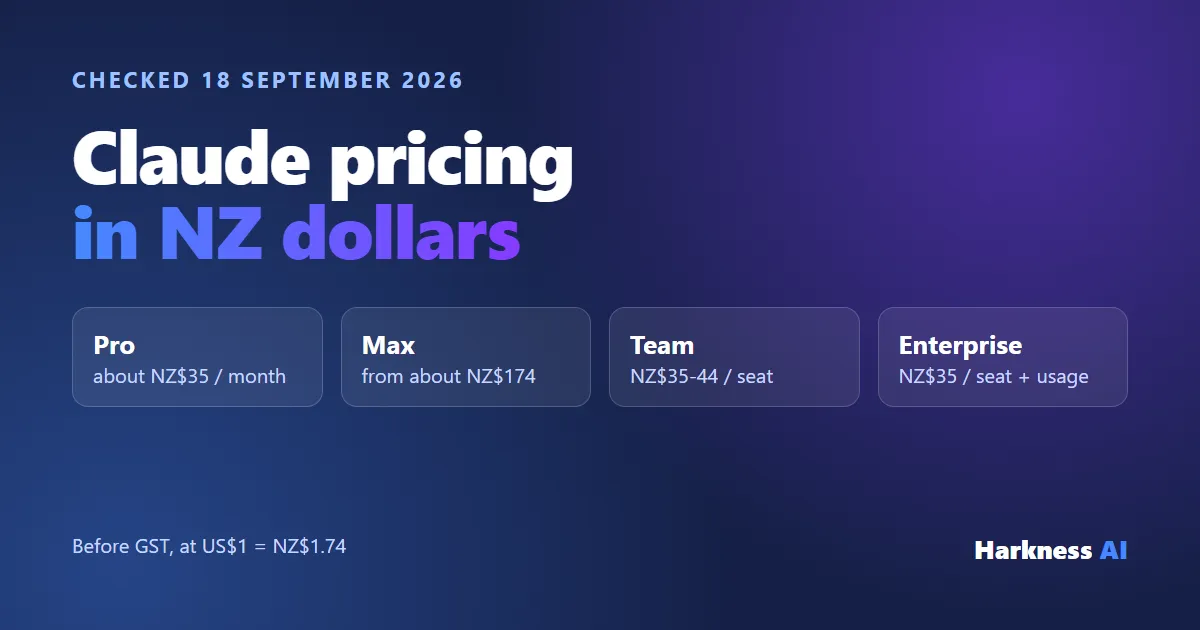
I was paying about NZ$200 a month for Claude. Now it’s NZ$440 a month: the Max 20x plan at about NZ$400 (since renamed Ultra - see Claude pricing in NZ), plus extra usage some months so I can finish a project or a client demo when I hit my limits.
Claude has become my AI operating system. Every manual, repetitive task in my business is a Claude skill - basically a standard operating procedure for how AI does that job. Proposals are the clearest example. They used to take me up to four hours each, pulling from meeting transcripts, email chains and texts into my template. Now Claude is connected to that software, follows the process I voiced out once, and is more accurate than me because it reads every line. Here’s how that works: automate client proposals with Claude.
In 2025 Claude was mostly a chat window and I was still copying and pasting in and out. Now everything I use is connected. It drafts in my email, checks Xero for invoices that need chasing, and checks my Stripe GST settings. Instead of lots of separate tools, Claude is the super agent.
What else did I swap out?
- Make to n8n. Make is a drag-and-drop workflow automation tool, and it was easy to get started with. But there was only so much custom automation we could build, so we moved to n8n at about NZ$56 a month. Most of the back-end automation for clients and our own work now runs there.
- Gamma and Canva to Claude Design. Gamma was the go-to AI presentation tool, and early Claude slides weren’t close. Now I load my brand guidelines and templates into Claude Design and the output stays consistent instead of looking like every other AI deck. That cut Gamma at around NZ$20 to NZ$30 a month, and Canva went the same way.
- ChatGPT, back again. I cancelled ChatGPT at the end of 2025 because it couldn’t connect to my tools and OpenAI seemed focused on user numbers rather than business use. They’ve since caught up: connectors, custom MCP servers and Codex as the Claude Code competitor. I’ve just resubscribed at around NZ$40 a month, mainly because its image model is still the best I’ve used.
What did I add in 2026?
- Post Everywhere, about NZ$34 a month. I post to YouTube, LinkedIn, TikTok, Instagram and Facebook. Instead of logging into each one, I upload once and it fires at 3pm on a Tuesday. It has an MCP server, so Claude can pull post analytics, update captions, and take videos from a Google Drive folder through to scheduled posts without me touching it.
- Resend. Email for client web builds and our own sites, like welcome emails when someone signs up. We’re also deciding between Resend and a newsletter tool like beehiiv for Blake’s AI Briefing and the Young Kiwis in AI newsletter.
- A Xero MCP connector, about NZ$10 to NZ$12 a month. Cheap for how much invoicing time it saves. More on that in automate your accounting with Claude and Xero.
What about development and hosting?
Supabase is the back-end database for client projects: user authentication, two-factor and project data. It was NZ$131 a month in December and is now NZ$269, because more projects have gone live. You pay per project, so that’s a good problem to have. Vercel handles domains and hosting at about NZ$106 a month for two seats, me and my AI engineer, plus some analytics. Google Workspace is unchanged.
Is NZ$1,050 a month worth it?
It’s a lot of money for AI tools, so here’s how I look at it. If I charge out at NZ$100 an hour, NZ$690 a month only had to save me seven hours. NZ$1,050 has to save about 10.5 hours a month. It saves far more than that, and at a higher charge-out rate the break-even drops further.
Honestly, the ROI is insane. My website, client projects, marketing and outreach all run on this stack. The business wouldn’t exist in its current form without it.
What did I learn from 2025 to 2026?
- Pick one main hub. I was split between Claude and Cursor. Now it’s Claude, running out of my Harkness AI Ops repository: a folder of Markdown files covering finance, clients, marketing, proposals, decks and PDFs. Claude can read all of it, and because it’s just files, it’s model-agnostic. My ChatGPT subscription can run on the same repository with the same skills.
- Look for overlap. I kept paying for Gamma because I hadn’t spent an hour teaching Claude to make good slides. Once I did, I cut it. General models can often do what a specialist tool does, if you give them the right examples.
- Pay for what generates revenue. Supabase, Vercel and Resend are costs, but they earn ongoing hosting and maintenance fees. Claude produces my marketing, SEO and GEO work. Make sure each tool feeds back into the business.
- Get AI to audit your subscriptions. If your accounts are in Xero and Claude is connected, ask it what you’re paying for. I found a few I didn’t realise I still had.