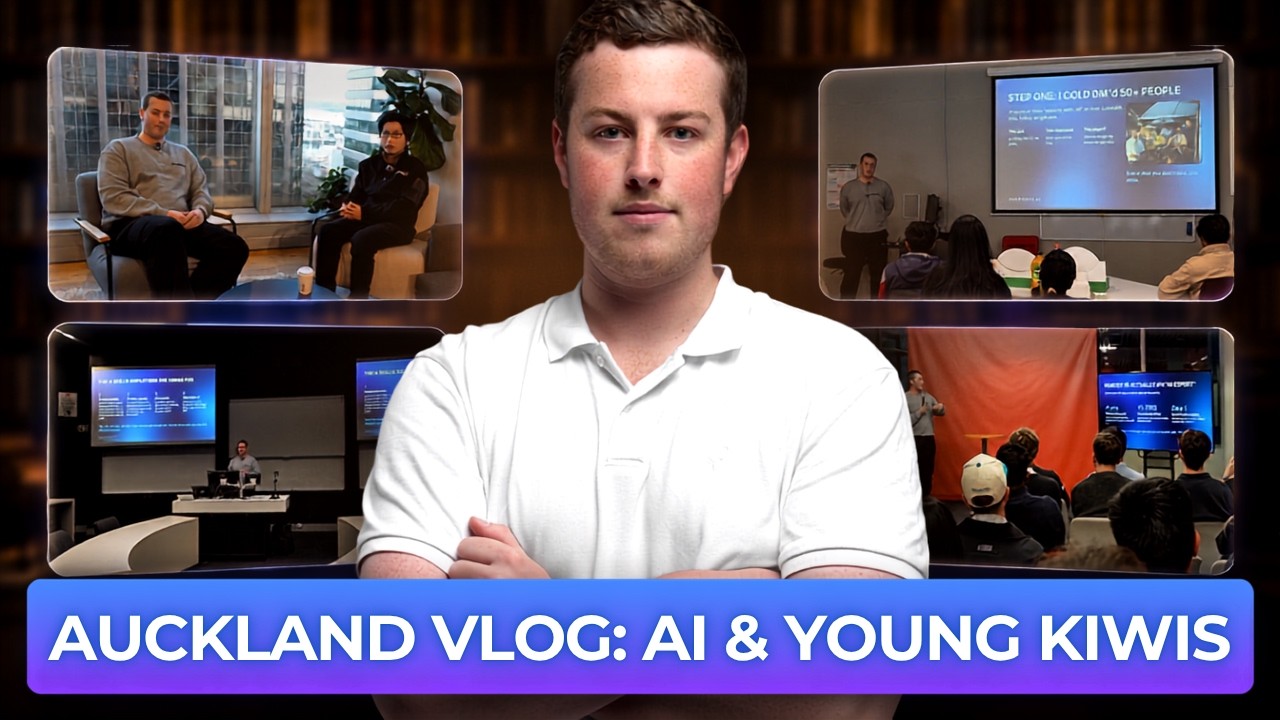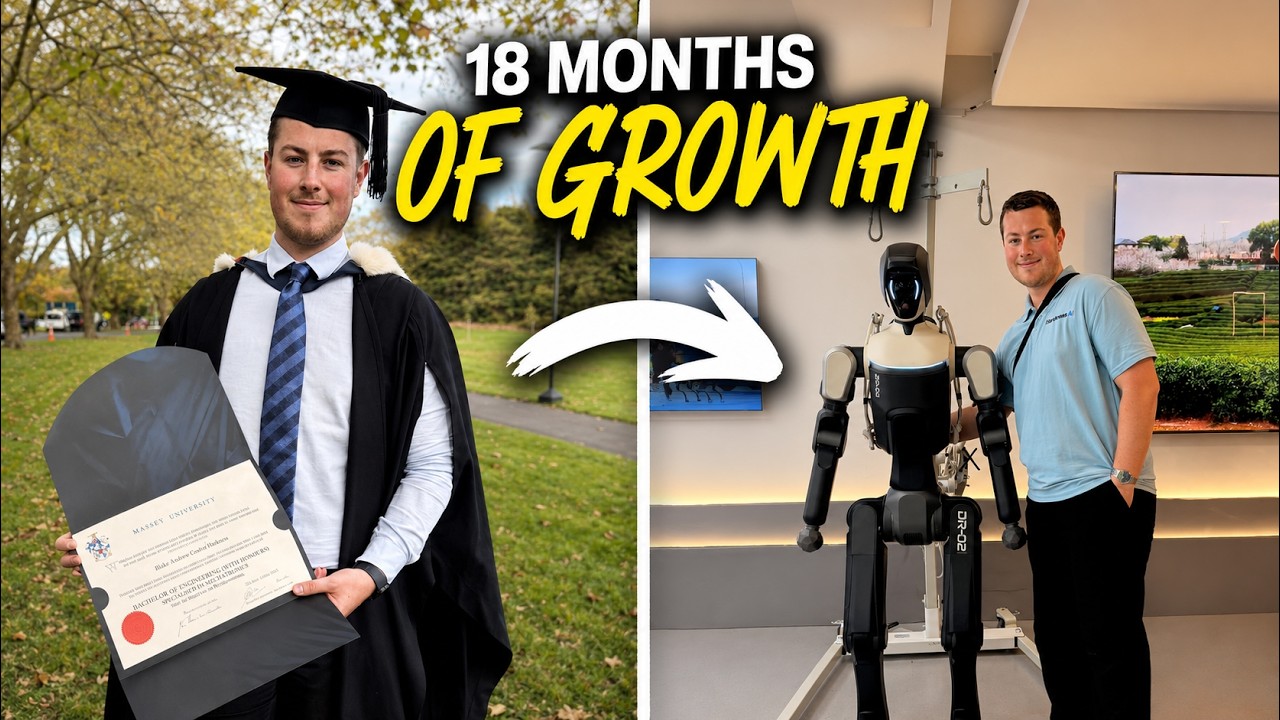
I gave this talk to a room of New Zealand students. It covers how I went from a mechatronics student to an AI engineer in about 14 months, what skills I think students need now, and what to do on Monday morning. Here is the written version.
Is a degree still worth it now that AI can answer the questions?
I started out wanting to be a teacher. I coached sports and did tutoring, but the salary put me off, so I chose engineering and did a mechatronic engineering degree at Massey University.
About halfway through, ChatGPT was released. I put my exams and assignments through it and realised quickly that AI could answer most of what I was being taught. That worried me about my career.
Then I changed my mind. The degree is not worthless. It taught me how to solve problems and gave me domain expertise. AI is a tool I can use to do the job a lot better.
How do you stand out in a hard graduate job market?
The graduate market is tough. You compete against hundreds of people, and everyone now has a perfect AI-written CV. So how do you stand out?
My answer was to become the magnet instead of chasing roles. I started posting on LinkedIn and YouTube. The early videos were cringe, and you can still go back and watch them. But within six months, while I was still working at MainPower, I had seven job offers across New Zealand and one in Australia. One offer was double my salary. I had not applied for any of them, and I spent nothing on ads.
Posting is cringe until it works. Almost a million views over eight months is nice, but views are not the point. The point is who is watching. Hardly anyone posts about real engineering work in New Zealand, so the people who do see it are exactly the right audience.
I also cold messaged around 75 people on LinkedIn who had AI in their job title. About half replied. Most people like talking about their own journey, and it taught me where AI adoption in New Zealand really sits: a lot of people are lost. I tell the longer version of this story in what I do as an AI engineer in New Zealand.
What did the timeline look like?
- November 2024: started a graduate role at MainPower, a company of about 140 staff.
- May 2025: started posting online.
- Soon after: my first paying client, who found me through a YouTube video.
- August 2025: hired my first team member.
- Late 2025: a coffee chat led to a role at Patersons. Today I work there three days a week while running my own company.
One coffee chat led to a job. One YouTube video led to a client. One LinkedIn message showed me what the whole AI market looked like. Small things add up like a snowball.
What AI skills do students need to get hired?
Universities mostly treat AI as cheating and block it. In industry, if you can do something faster and safely, you should. These are the skills I think matter most:
- AI tool proficiency. Can you use ChatGPT or Claude, and do you know which tool is better for which job? Can you prompt well and build custom GPTs?
- Process automation. In any role, ask why a task is done the way it has been done for 20 years. Making it better makes you very valuable.
- Domain knowledge. An AI skill set without an understanding of how people actually do their jobs is not enough. You need the blend of both.
- Critical thinking. AI makes things up and can be confidently wrong. If you hand your manager an AI-written report that is garbage, you own it. Learn to verify what AI gives you.
- Communication. Large language models are prediction engines, so how clearly you communicate decides the quality of the output. Human-to-human relationships also matter more as fake AI content grows.
For more on what employers say they want, see what NZ employers actually hire for in AI.
Why do companies need people with these skills?
Here is a simple example. Say someone spends 2.5 hours a week reading documents and pulling out information, across 10 staff. That is around 1,300 hours a year. If they use ChatGPT to extract the information and only spend 30 minutes a week validating it, each person saves 2 hours a week. Across 10 staff that is about 1,040 hours a year. At a $100 an hour charge-out rate, that is roughly $104,000 saved a year from one small change.
Much of my client work is not really AI. It is business automation. A lot of businesses still have people copying information from one system and pasting it into another.
How do students actually start learning AI?
Universities and schools are not teaching this properly yet. So just start. Pick a problem you or someone close to you has, and build a solution to it. My first project was a small web app that scanned a photo of a makeup product and found cheaper alternatives. It was not engineering, but it taught me how to turn someone’s problem into a working product.
The two students I have hired both stood out for the same reason. One was already testing the newest model on the day it launched, and had built his own side project for lecture notes. The other was a first-year civil engineering student who emailed to say lecturers were not teaching him AI and asked to work for free. Curiosity and putting themselves out there made the difference. If you want AI tools that help you study rather than cheat, start with 4 free AI tools to study smarter.
If you want a community, I founded Young Kiwis in AI for young professionals. We hold a member spotlight and a talk on the last Monday of every month, plus in-person events. If you want me to speak to your students, see my speaking page.
What should a student do this week?
You will not remember everything above. The message is simple:
- Post something about your work on social media.
- Build a small project that solves a real problem.
- Talk to someone working in the field.
The best time to start was yesterday. The second best time is now.